









A Certified Management Accountant makes significant contributions to Strategic Financial Management through connecting finance and strategies. While most accountancy positions tend to be technical and focused on compliance, CMAs possess the knowledge of analysing and linking financial information to business strategies. As a result, professionals participate in developing strategies in relation to budgeting, investing, reducing costs and managing risks for achieving organisational growth.
In today’s rapidly changing environment, the role of CMA course professionals is that of strategic partners for organisations. Performance measurement, forecasting and financial modeling are some tools employed by professionals for helping organisations make informed decisions. In addition, they help organisations deal with the challenges posed by the ever-changing market through increasing profits and sustaining their financial positions.
Key Role of International CMA Professionals In Strategic Finance Management
1. Strategic Planning and Decision Support
Certified Management Accountants help in defining the future course of action for the organizations through their analysis of numbers. The analysis is based on reviewing the financial statements, market conditions, and internal performance measures. The information helps the management in making appropriate business decisions. Their expertise makes sure that each decision aligns with the organisation’s financial goals and risk appetite.
Beyond analysis, CMA course professionals participate in forecasting and scenario planning. They assess varied business strategies, evaluate financial implications and recommend the most viable path. The active participation of CMAs keeps the business ahead of its competitors.
2. Budgeting and Financial Forecasting
It is important to note that CMA experts are entrusted with the task of preparing elaborate budgets that are aligned with the organizational strategies. They ensure that the organization has adequate funds allocated to the various departments while at the same time ensuring fiscal prudence. The budgeting process undertaken by CMA experts utilizes both past records and future predictions.
Another vital area where the Certified Management Accountant professionals have great expertise is the preparation of detailed financial forecasts. It comprises complicated techniques for projecting future cash flows, as well as financial inflows and outflows.
3. Cost Management and Optimization
Certified Management Accountants have several attributes that set them apart. One such attribute is cost management. They analyze costs and suggest ways through which organizations can reduce their costs effectively. This ensures that the organizations benefit from maximum profit and maintain their efficiency.
They establish an effective cost control mechanism and performance measures. Through constant monitoring of costs and benchmarking them against standard industry rates, they assist organizations in gaining an advantage over their competitors. When considering the financial performance and setting of prices, this competency yields great benefits.
4. Risk Management and Internal Controls
It is essential to note that CMA course professionals are very important in assessing risks associated with finance. They evaluate market, operational, and investment risks. By doing so, they come up with ways to reduce these risks. This way, the organization avoids making financial losses.
Besides, they also put in place internal controls within organizations. These systems ensure accuracy in financial reporting, maintain compliance with regulations and prevent frauds. Certified Management Accountants improve the accuracy and dependability of financial data by enhancing governance systems.
5. Performance Management and KPI Analysis
CMA plays a very important role in measuring and improving organizational performance through Key Performance Indicators (KPIs). They set up KPIs in line with the objectives set by the organization and measure the achievement made in the process. This allows the managers to determine whether their organization is doing well.
CMAs provide practical solutions to the issues related to organizational performance. They help organizations bridge the gap between the planned performance levels and the actual achievements.
6. Investment Appraisal and Capital Budgeting
The Certified Management Accountants look into the investment opportunities. By using various techniques like NPV, IRR, and payback period, they can analyze whether or not an investment is feasible.
Their analysis ensures that investments yield maximum profits and match up with the organizational strategies. Certified Management Accountants even help in making decisions regarding capital budgeting by analyzing different investments. Based on their risk assessment and future gains, Certified Management Accountants help in investing in profitable opportunities.
7. Financial Reporting and Strategic Communication
Certified Management Accountants make certain that financial statements are accurate and presented on time because this is important in formulating strategies. Reports curated by CMA course professionals are detailed and provide an overview of how an organization performs financially.
Additionally, professionals act as strategic communicators between finance and management teams. Their ability to turn complicated financial information into useful information is what allows non-financial decision makers to make well-informed decisions. The role that the finance expert plays in connecting this piece is vital in strategic financial management.
Final Takeaway
Certified Management Accountant holds a crucial position in Strategic Financial Management by providing the link between financial expertise and business strategy to ensure data-driven decisions, cost optimization, risk management, and sustained growth for organizations.
Take the next step towards being a strategic finance manager! Reach out to the Zell Education experts now to discover more about our CMA program and start on your path to an impressive global finance career.
FAQs
1. In what way does the Certified Management Accountant promote business expansion?
They uncover avenues for reducing costs and improving resource distribution.
2. How do Certified Management Accountants assist in managing performances?
They assess financial indicators and propose changes to improve efficiency.
3. Are Certified Management Accountants instrumental in managing risks?
Indeed, they assess financial risks and introduce measures that will help in combating these risks.
____________________________________________________________________________
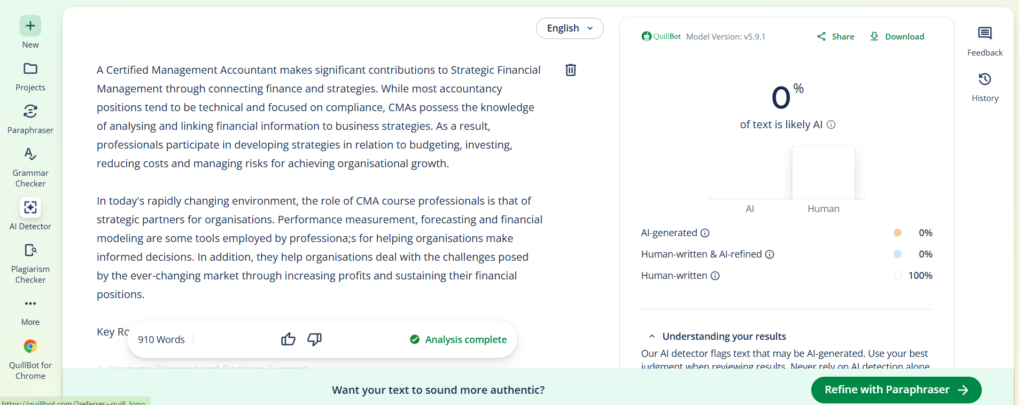
Quillbot Report
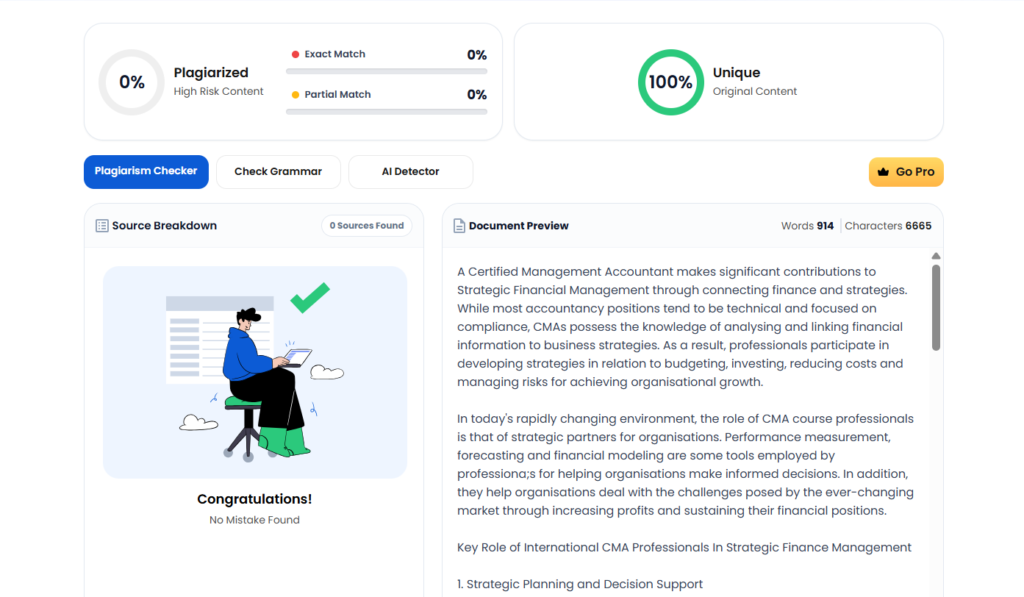
Plagiarism Report




Decided to set aside time later to read more carefully, and a stop at forwardmovementengine reinforced that decision, content that earns a calendar entry rather than just a passing read is in a different tier altogether and this site is clearly working at that elevated level which I really do appreciate as a reader today.
Reading this in a quiet hour and finding it suited the quiet, and a stop at signalclarifiesaction extended the quiet reading mood, content that matches its own optimal reading conditions rather than fighting them is content that has been thoughtfully calibrated and this site reads as having a particular reading mood in mind throughout.
I like this post, enjoyed this one regards for putting up. “The difference between stupidity and genius is that genius has its limits.” by Albert Einstein.