








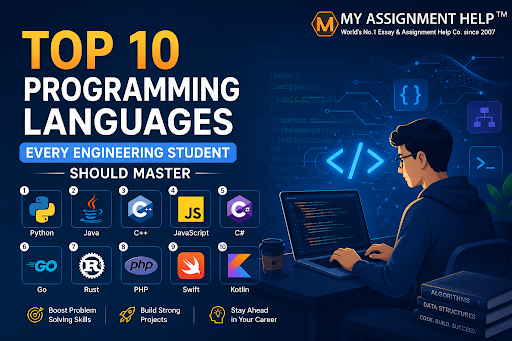
The landscape of modern engineering has shifted. No longer is a civil engineer just dealing with concrete, or a mechanical engineer just focusing on gears. Today, code is the invisible thread that connects every discipline. Whether it is simulating fluid dynamics, automating structural analysis, or managing massive datasets, the ability to program is a fundamental literacy. For students entering the field, the question is no longer “should I learn to code,” but rather “which language will give me the greatest advantage?”
The transition from theory to practice can be daunting, especially when deadlines loom and complex syntax errors stall your progress. Many students find themselves overwhelmed by the sheer volume of projects, often searching for reliable resources to do my programming assignment with precision and technical accuracy. When the pressure of high-stakes projects becomes too much, platforms MyAssignmenthelp provide the necessary guidance to help students understand complex logic while staying on track with their curriculum. Mastering the right languages early on ensures you have the tools to handle these challenges independently in the professional world.
1. Python: The Universal Entry Point
Python is the undisputed leader in the academic and professional world. Its syntax is remarkably close to the English language, making it accessible for those who are just starting. For engineers, Python is invaluable due to its extensive libraries like NumPy and SciPy for numerical integration and Matplotlib for data visualization. It is the primary language for artificial intelligence and machine learning, two fields that are currently revolutionizing every branch of engineering.
2. C++: The Powerhouse of Performance
If Python is the “easy” language, C++ is the “powerful” one. It provides low-level memory manipulation, which is essential for systems programming and embedded systems. Mechanical and electrical engineers often use C++ to program hardware, sensors, and robotics. Learning C++ teaches you how a computer actually processes information, providing a deep foundational understanding that makes learning any other language much easier.
3. Java: Building Robust Systems
Java remains a staple in the corporate world and for large-scale enterprise applications. Its “write once, run anywhere” philosophy makes it highly versatile. Many computer science and software engineering students will find that they frequently need help with java homework because of its strict object-oriented structure and complex memory management. However, mastering Java is worth the effort, as it remains the backbone of Android development and many back-end server environments.
4. MATLAB: The Engineer’s Calculator
While technically a high-level language and interactive environment, MATLAB is a standard tool across nearly all engineering departments. It is specifically designed for matrix manipulations, plotting of functions and data, and implementation of algorithms. From control systems to signal processing, MATLAB allows engineers to solve complex mathematical problems far faster than they could with traditional programming languages.
5. JavaScript: The Language of the Web
In the modern era, every project needs a user interface. JavaScript is the language of the web. Engineering students who understand JavaScript can build interactive dashboards for their data or create web-based tools that allow others to interact with their engineering models. With the rise of Node.js, JavaScript is also increasingly used for server-side programming, making it a valuable tool for full-stack awareness.
6. R: The Statistician’s Choice
For civil and environmental engineers who deal with massive amounts of environmental data or urban planning statistics, R is the go-to language. It is built specifically for statistical computing and graphics. While Python is a general-purpose language that can do statistics, R is a dedicated environment that offers specialized packages for almost any statistical test or data modeling scenario imaginable.
7. SQL: Managing the Data Deluge
Data is the new oil, and SQL (Structured Query Language) is the tool used to extract it. Engineers often work with large databases of project specifications, historical data, or sensor logs. Understanding how to query a database effectively is a vital skill. SQL allows you to communicate with databases to find the exact information you need to make informed engineering decisions.
8. Swift: The Gateway to iOS
For students interested in the mobile revolution, Swift is essential. Developed by Apple, it is used to build apps for iPhones and iPads. As more engineering firms move toward mobile-first field inspections and real-time data monitoring on mobile devices, knowing how to build or maintain these applications can make an engineering graduate stand out in a competitive job market.
9. Rust: The Future of Safety
Rust is a relatively new language but has quickly gained popularity for its focus on safety and performance. It prevents the common memory errors that plague C++ programs. Many tech giants are beginning to rewrite their core infrastructure in Rust. For engineering students looking to stay ahead of the curve, learning Rust demonstrates a commitment to modern, secure, and efficient coding practices.
10. C#: Versatility in Design and Simulation
C# is widely used in the industry for developing Windows desktop applications and game development via the Unity engine. For engineers, this is particularly relevant in the world of Virtual Reality (VR) and Augmented Reality (AR) simulations. Being able to create a 3D simulation of a bridge or a mechanical part using C# and Unity is a high-level skill that is increasingly in demand.
Strategies for Learning Multiple Languages
The key to becoming a proficient programmer is not to memorize syntax but to understand logic. Once you understand loops, conditionals, and data structures, moving from Python to Java or C++ becomes a matter of learning a new vocabulary rather than a new way of thinking.
Start Small and Build
Don’t try to learn all ten languages at once. Start with Python to build your confidence and understand the basics of logic. Once you feel comfortable, move to a lower-level language like C++ to understand performance, or a structural language like Java to understand architecture.
Apply Code to Real Engineering Problems
The best way to learn is by doing. If you are a mechanical engineering student, try writing a script to calculate the stress on a beam. If you are an electrical engineer, try programming a simple circuit simulation. Applying code to your specific field makes the learning process more relevant and much more interesting.
Conclusion
The intersection of engineering and computer science is where the most exciting innovations are happening today. By mastering these programming languages, engineering students empower themselves to build, simulate, and innovate in ways that were impossible a generation ago. Whether you are automating a simple task or building the next great piece of infrastructure, your code is the tool that will bring your designs to life.
Author Bio
Jack Thomas is a Senior Academic Consultant at MyAssignmenthelp with over a decade of experience in guiding engineering students through complex technical curricula. When he isn’t helping students decode the intricacies of software development or structural analysis, Jack is an avid hiker who enjoys exploring the rugged trails of the backcountry. He is also deeply committed to youth mentoring, volunteering his time to help the next generation develop the digital skills they need to thrive in a modern economy.
Frequently Asked Questions
1. Which language should I learn first?
Python is generally recommended as the first language due to its readability and wide range of applications in both academia and the professional industry.
2. Do I need a powerful computer to learn these languages?
Most of these languages can be learned on a standard laptop. However, for languages like C++ or heavy simulations in MATLAB, having more RAM and a faster processor can certainly help.
3. Is it better to be an expert in one language or a beginner in many?
Initially, it is better to be proficient in one (like Python) so you understand the core concepts of programming. Once that foundation is solid, expanding your knowledge to other languages is much easier.
4. How much math do I need to know to program?
For engineering programming, a solid grasp of algebra and logic is essential. Specialized fields may require calculus, linear algebra, or statistics, but the code itself is mostly about logic.
5. Are there free resources to learn these languages?
Yes, there are many free platforms, documentation sites, and community forums where you can learn to code. Practice and consistency are the most important factors.