








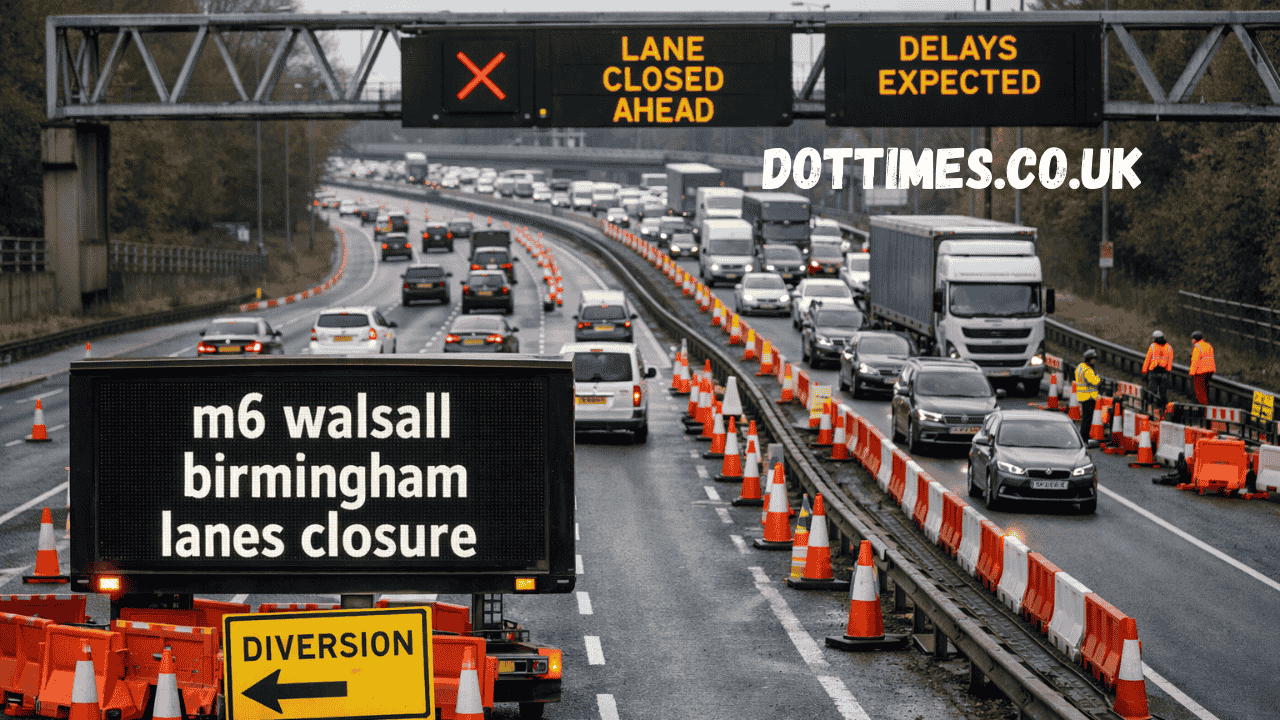
The ongoing situation around the m6 walsall birmingham lanes closure has become a regular concern for drivers traveling through the West Midlands. This stretch of motorway connects key areas and handles a heavy mix of commuter and freight traffic every day. Over the past year, closures have become more frequent due to maintenance, infrastructure upgrades, and unexpected incidents. Many drivers now expect delays when passing between Walsall and Birmingham, especially during peak hours. Understanding what is causing the m6 walsall birmingham lanes closure can help commuters better plan their journeys and avoid unnecessary stress.
where the closures are happening on the m6
The m6 walsall birmingham lanes closure mainly affects sections between junction 10 and junction 7, along with nearby junctions closer to Birmingham. These areas are some of the busiest parts of the motorway network, which makes any disruption more noticeable. Junction 10 near Walsall has seen repeated closures due to ongoing improvement works and entry slip adjustments. Moving toward Birmingham, junctions 6 and 5 are also frequently impacted due to structural maintenance and resurfacing projects. Because these closures happen across multiple junctions, congestion often spreads well beyond the actual work zones.
Another factor is how closely spaced these junctions are, which means traffic builds up quickly when lanes are reduced. Even a single lane closure can slow down thousands of vehicles during rush hour. Drivers traveling through the m6 walsall birmingham lanes closure zone often experience delays even if they are not directly passing through the construction area. This makes the entire stretch feel unreliable, especially for daily commuters. As a result, many drivers are now actively looking for alternative routes.
timeline of recent and ongoing closures
The timeline of the m6 walsall birmingham lanes closure shows that this is not a one-time disruption but part of a longer sequence of planned works. Several closures were scheduled between March and April 2026, mostly during overnight hours. These included full carriageway shutdowns as well as partial lane closures for resurfacing and repairs. While nighttime scheduling is intended to reduce disruption, it still affects logistics operations and late-night travel.
In addition to planned maintenance, shorter closures have appeared with little notice due to safety inspections or urgent repairs. This creates uncertainty for drivers who rely on consistent travel times. The m6 walsall birmingham lanes closure has also overlapped with other nearby projects, making the situation more complicated. When multiple sections are affected at once, traffic flow becomes difficult to manage. This ongoing pattern suggests that disruptions may continue for the foreseeable future.
key reasons behind repeated lane closures
There are several clear reasons why the m6 walsall birmingham lanes closure keeps happening, and most of them are tied to long-term infrastructure challenges. The motorway was built decades ago and is now under pressure from modern traffic levels. Continuous wear and tear require regular repairs to keep the road safe. At the same time, upgrades are being carried out to bring the motorway up to current standards.
Some of the main causes include:
- bridge joint replacements to improve structural safety
- resurfacing work to repair worn-out road surfaces
- smart motorway upgrades to improve traffic management
- electrical and lighting work linked to larger transport projects
Each of these activities requires lane restrictions or full closures to ensure worker safety. While frustrating, these efforts are necessary to maintain the motorway’s long-term usability. The repeated nature of the m6 walsall birmingham lanes closure reflects how much work is needed to modernize this section.
the role of hs2 and infrastructure projects
Another major contributor to the m6 walsall birmingham lanes closure is the ongoing development of large infrastructure projects like HS2. Work related to rail expansion often overlaps with motorway routes, requiring adjustments to nearby roads. This includes changes to slip roads, lighting systems, and supporting infrastructure. Even when the main carriageway remains open, these works can still create bottlenecks.
The presence of multiple construction projects in the same region increases the likelihood of delays. Drivers may face restrictions not just from one project, but from several happening at once. This layered disruption is one of the reasons why the m6 walsall birmingham lanes closure feels constant rather than occasional. As these projects continue, short-term inconvenience is expected to remain part of the travel experience.
accidents and unexpected disruptions
While planned works are a major factor, accidents also play a big role in the m6 walsall birmingham lanes closure situation. Crashes involving multiple vehicles can shut down several lanes instantly. In some cases, three out of four lanes have been closed following serious incidents. This leads to long delays and heavy congestion stretching for miles.
Unexpected disruptions are harder for drivers to prepare for, which makes them more frustrating. Even minor incidents, like a broken-down vehicle, can trigger lane closures. When this happens during peak hours, the impact becomes much worse. The combination of planned works and sudden incidents is what makes the m6 walsall birmingham lanes closure particularly challenging for regular users.
how closures affect daily commuters
The real impact of the m6 walsall birmingham lanes closure is felt by people who rely on this route every day. Commuters traveling between Walsall and Birmingham often face unpredictable journey times. A trip that should take 20 minutes can easily turn into an hour during heavy congestion. This affects not just personal schedules but also business operations and delivery services.
Common effects on drivers include:
- longer travel times during peak hours
- increased fuel consumption due to stop-start traffic
- difficulty planning arrival times
- higher stress levels during daily commutes
These challenges have made the motorway less reliable for many users. As a result, some drivers are exploring alternative routes, even if they are longer in distance. The ongoing m6 walsall birmingham lanes closure continues to shape how people move around the region.
strategies to avoid delays on this route
While the m6 walsall birmingham lanes closure cannot be avoided entirely, there are ways to reduce its impact. Planning ahead can make a noticeable difference in travel time and stress levels. Drivers who stay informed about closures are better equipped to adjust their routes or schedules.
Here are some practical tips:
- travel outside peak hours whenever possible
- check traffic updates before starting your journey
- consider alternative routes through local roads
- allow extra time for unexpected delays
Using navigation apps that provide real-time updates can also help drivers react quickly to changing conditions. Even small adjustments can save time when dealing with frequent disruptions. The key is to treat the m6 walsall birmingham lanes closure as a predictable challenge rather than a surprise.
long term outlook for the motorway
Looking ahead, the current wave of construction and repairs may lead to better conditions in the future. The goal of these projects is to improve safety, reduce congestion, and support growing traffic demand. However, the transition period is likely to remain difficult for drivers. The m6 walsall birmingham lanes closure is part of a broader effort to modernize the motorway network.
Once upgrades are completed, drivers may benefit from smoother traffic flow and fewer breakdown-related issues. Smart motorway technology is expected to improve how traffic is managed in busy sections. Even so, the success of these improvements will depend on how well they handle increasing traffic volumes. For now, patience remains essential for anyone using this route regularly.
conclusion
The m6 walsall birmingham lanes closure is not a single issue but a combination of planned upgrades, aging infrastructure, and unexpected incidents. This stretch of motorway has become one of the most actively maintained areas in the region due to its importance and heavy usage. While closures are frustrating, they are part of a necessary process to improve long-term road conditions. Drivers who understand the reasons behind these disruptions are better prepared to deal with them. As work continues, the focus remains on creating a safer and more efficient motorway for the future.
faqs
- why is the m6 walsall birmingham lanes closure happening so often
The frequent closures are mainly due to ongoing maintenance, resurfacing, and infrastructure upgrades needed to keep the motorway safe and functional. - which junctions are most affected by the m6 walsall birmingham lanes closure
Junctions between 10 and 5 are commonly affected, especially areas near Walsall and central Birmingham. - are the closures usually during the day or night
Most planned closures happen overnight, but delays can still extend into daytime due to traffic buildup. - how can drivers avoid delays caused by the m6 walsall birmingham lanes closure
Drivers can avoid delays by traveling outside peak hours, checking traffic updates, and using alternative routes when possible. - will the m6 walsall birmingham lanes closure situation improve in the future
The ongoing works are expected to improve road conditions in the long term, but short-term disruptions may continue until projects are completed.